All published articles of this journal are available on ScienceDirect.

Streptokinase as an Effective Drug in Safeguarding the Lives Of Syrian Patients With Myocardial Infarction During The Syrian Crisis
 iD
Karam Al kounsol1
Ali Hamdan1
Bashar Diban1
Ammar Akid1
MHD Yassin Bani Marjeh1
iD
Karam Al kounsol1
Ali Hamdan1
Bashar Diban1
Ammar Akid1
MHD Yassin Bani Marjeh1
Authors Info & Affiliations
Abstract
Introduction
Throughout the protracted years of conflict in Syria, which precipitated a profound economic and humanitarian crisis, the nation also witnessed the disintegration of its public healthcare system. This breakdown severely hampered the ability to adhere to established international protocols for managing myocardial infarction cases. Consequently, a national protocol was established whereby streptokinase is prioritised as the initial treatment strategy in all public hospitals. This approach has demonstrated its efficacy in preserving the lives of thousands of patients with STEMI.
Methods
This cross-sectional study included 185 patients seeking care at the emergency department. The study spanned six months between 2022 and 2023. All included participants presented with STEMI and experienced chest pain within the first 24 hours of symptom onset. Streptokinase therapy was initiated promptly for all patients.
Results
Clinical response and ECG results one hour after streptokinase treatment revealed a reduction in chest pain and ST-segment elevation. Among 145 patients, 77.5% experienced improvement, while 40 patients, representing 22.5%, showed no benefit from the treatment. Among the study patients treated with streptokinase, 152 underwent cardiac catheterisation to assess the condition of their coronary arteries and determine the next steps for interventional treatment, while 33 did not undergo coronary angiography. Among those who underwent angiography, the majority benefited from streptokinase treatment, as 69.5% (n=129) of patients showed a patent target artery with favourable blood flow outcomes (TIMI 2-3).
Discussion
Streptokinase, recognised as the first generation of thrombolytic agents, has become infrequently utilised in many countries, particularly within low-income settings, where its cost-effectiveness makes it a viable option for thrombolytic therapy. However, during the Syrian conflict, the constrained medical landscape rendered streptokinase the sole thrombolytic option in many hospitals. Consequently, it was adopted as the primary emergency treatment in all public hospitals. This shift was necessitated by a severe shortage of essential materials and the unavailability of adequate equipment required for emergency coronary interventions.
Conclusion
Early intravenous fibrinolysis improves survival in patients with STEMI, as improvement in global LV function, like survival, is related to the time of initiation of fibrinolytic treatment, with the greatest improvement occurring with the earliest therapy. This conclusion stems from our experience treating thousands of patients in Syrian public hospitals over a decade, during the tumultuous period of the Syrian revolution and ongoing war.
1. INTRODUCTION
Myocardial infarction (MI) remains the leading global cause of mortality, underscoring the critical importance of prompt treatment initiation as emphasized by all major clinical guidelines. The American College of Cardiology (ACC)and the European Society of Cardiology (ESC) advocate for percutaneous coronary intervention (PCI) as the preferred first-line therapy for myocardial infarction, especially in cases where thrombus formation necessitates timely coronary intervention [1, 2]. However, the applicability of these guidelines must account for contextual and situational variations. Throughout the protracted years of conflict in Syria, which precipitated a profound economic and humanitarian crisis, the nation also witnessed the disintegration of its public healthcare system. This breakdown severely hampered the ability to adhere to established international protocols for managing myocardial infarction cases. Consequently, a national protocol has been established whereby streptokinase, a first-generation thrombolytic agent, is prioritized as the initial treatment strategy in all public hospitals. This approach has consistently demonstrated its efficacy in decreasing mortality rates and the occurrence of re-infarction during the critical initial hours of STEMI, as supported by findings from multiple meta-analyses [3]. The present study seeks to examine the unique Syrian experience during the Syrian crisis, highlighting the practices implemented within government hospitals to save thousands of lives. This analysis emphasizes their success despite significant challenges, including acute shortages of medical equipment, supplies, and sufficient infrastructure to adhere fully to international STEMI guidelines. In this study, we aim to assess the effectiveness of streptokinase in the management of MI among patients presented to the emergency department within the first 24 hours of chest pain. The majority of patients treated with streptokinase showed both clinical improvement and favorable outcomes in subsequent planning. This was further validated through routine coronary angiography, which revealed that the highest proportion of patients benefited from the treatment by having a patent target artery. Through the monitoring of the ejection fraction (EF) of the left ventricle as an indicator of the efficacy of streptokinase treatment, the majority of patients demonstrated a preserved or mildly reduced EF.
2. METHODS
2.1. Study Design
This cross-sectional study included 185 patients seeking care at the emergency department. The study spanned six months between 2022 and 2023. All included participants presented with STEMI and experienced chest pain within the first 24 hours of symptom onset. Following confirmation of the diagnosis, patients were treated according to international clinical guidelines, receiving combination therapy comprising aspirin (300 mg), clopidogrel (300 mg), heparin, and atorvastatin (80 mg). Streptokinase therapy was initiated promptly for all patients at a dose of 1,500,000 units within an hour after contraindications had been clinically ruled out. In response to the economic crisis, which introduced numerous logistical challenges, the principal approach to managing MI patients involved a pharmacoinvasive strategy. Participants in the study were categorized into two distinct groups. The first group, comprising 152 patients, received streptokinase therapy accompanied by coronary angiography within 72 hours of hospital admission. In contrast, the second group, consisting of 33 patients, underwent streptokinase administration without subsequent coronary intervention during their hospitalization. The primary objective of the study was to assess the efficacy of the non-specific thrombolytic agent streptokinase as a first-line therapeutic option.
2.1.1. Inclusion and Exclusion Criteria
Patients presenting more than 24 hours after the onset of chest pain were excluded from the study, as they were managed through a monitoring-only strategy in the CCU. Additionally, individuals with contraindications to streptokinase were excluded and directed toward percutaneous coronary intervention (PCI) as an alternative treatment modality.
2.2. STEMI
An acute ST-segment elevation myocardial infarction (STEMI) occurs due to the blockage of one or more coronary arteries, leading to transmural myocardial ischemia and subsequent tissue injury or necrosis. The primary underlying mechanism is usually the rupture of an atherosclerotic plaque, followed by thrombus formation within the coronary artery, although other pathways can also contribute to its onset. Diagnosis is established through characteristic findings on an electrocardiogram (ECG), such as ST-segment elevation in specific leads, which may be supplemented by elevated cardiac troponin levels in blood tests. Prompt treatment aims to restore blood flow to the affected myocardial tissue, most commonly achieved through reperfusion therapy using PCI. When evaluating patients presenting with the acute onset of chest pain, the initial assessment should include an ECG and measurement of troponin levels. The ACC and ESC have outlined specific ECG diagnostic criteria for STEMI: ST-segment elevation is considered significant if it is newly observed at the J point in at least two contiguous leads, surpassing 0.1 mV in all leads except V2 and V3. For leads V2 and V3, the thresholds are defined as follows: greater than 0.2 mV for men over 40 years old, greater than 0.25 mV for men under 40 years old, and greater than 0.15 mV for women [4, 5]. In our study, this definition was used to classify patients presenting to the emergency department with symptoms consistent with angina. These symptoms included diffuse compressive chest pain, shortness of breath, and generalized discomfort such as sweating and nausea, accompanied by ECG results indicating STEMI. Upon admission, cardiac enzyme tests were promptly ordered, and streptokinase treatment was started without delay.
2.3. Treatment of STEMI
The temporal dimension plays a critical role in the management of STEMI, as the initial minutes represent a pivotal window, often referred to as the “golden hour,” to optimize patient survival outcomes. To underscore the significance of timely intervention in these emergencies, the concept of “door-to-balloon time” has been established as a benchmark, highlighting the urgency of rapid response and treatment initiation in STEMI cases. Patients should undergo PCI within 90 minutes of presentation at a PCI-capable hospital or within 120 minutes if transfer to a PCI-capable hospital is required. If PCI is not possible within 120 minutes of first medical contact, fibrinolytic therapy should be initiated within 30 minutes of the patient's arrival at the hospital. Patients should be promptly transferred to a PCI center after starting lytic therapy. If fibrinolysis fails or signs of re-occlusion or reinfarction, such as recurring ST-segment elevation, emerge, immediate angiography and rescue PCI are necessary [6].
2.4. Evaluation of the Effectiveness of Streptokinase Emergency Treatment/Clinical Response
Successful clinical reperfusion was identified based on meeting at least two of the following criteria within one hour following thrombolytic therapy: a substantial reduction in pain (a decrease of 5 points on a 1 to 10 subjective scale), a decrease of 50% or more in the sum of ST segment elevation, or a sudden and significant rise in creatine kinase levels (exceeding twice the upper-normal limit or baseline elevated values [7].
2.5. Coronary Angiography after Streptokinase Treatment
To evaluate the patency of the coronary artery, the TIMI classification system has been employed. This system categorizes blood flow in coronary arteries into four grades: grade 0 (absence of flow), grade 1 (penetration without significant perfusion), grade 2 (partial perfusion), and grade 3 (complete perfusion). For TIMI grade 3, the antegrade flow observed distally must be comparable in velocity to that observed proximally. It was observed that patients who demonstrated clinical improvement, corroborated by electrocardiographic findings, following emergency treatment with streptokinase typically exhibited a patent target coronary artery, as represented by TIMI grades 2 or 3. Conversely, for patients who derived no apparent benefit from thrombolytic therapy, TIMI grades 0 or 1 were assigned, signifying that the artery remained either entirely occluded or exhibited minimal patency [8].
2.6. Statistical Analysis
The 2019 version of Excel and IBM SPSS Statistics version 29.0.10 were used to analyze relationships among variables and generate statistical curves. Pearson's correlation coefficient was employed to assess both the strength and direction of the associations between the variables. Additionally, a t-test was conducted to evaluate the statistical significance of the differences observed between the variables. A p-value of less than 0.05 indicated that the differences were statistically significant, whereas a p-value greater than 0.05 suggested that the observed differences could be attributed to random chance or sampling variability.
3. RESULTS
Over the 6-month study period, 185 patients treated with streptokinase were enrolled. The majority of participants, accounting for 83.78%, were male. The average age of the study population was 56.04 ± 11.6 years, with an age range spanning from 32 to 82 years. Smokers accounted for 81.62% of the study sample, while non-smokers made up 18.38%. Patients with a BMI lower than 25 accounted for 28%. Those with BMI values between 25 and 30 made up 47%, while 21% had BMI values between 30 and 35. Meanwhile, only 3% of patients had a BMI exceeding 35.
Among the patients, 58.92% had no history of heart disease, while 41.08% had a history of heart-related conditions. This history encompassed MI, confirmed coronary artery disease, prior PCI, or CABG. The study revealed the percentages of diseases linked to heart disease among the patients analyzed. Results showed that 25% of the sample had diabetes, 32% had hypertension, 4% suffered from hyperlipidemia, and 2% experienced a stroke. Ten patients passed away during the study. One death resulted from an early complication during the administration of streptokinase, while the remaining nine occurred within the first 72 hours of the patients' hospital stay.
This study found that 51.2% of patients experienced an anterior myocardial infarction (MI), while inferior and lateral MIs were observed in 42.6% and 6.2% of cases, respectively. Patients with contraindications to streptokinase were excluded from the study, as noted earlier. However, poor capabilities and resource constraints necessitated the repeat administration of streptokinase to save the lives of two individuals who had previously received the treatment. One patient had experienced a STEMI two months prior, while the other had suffered one four months earlier.
The time from the onset of chest pain to the first medical contact (FMC) in the emergency department varied between 15 minutes and 24 hours (Fig. 1). Of the patients, 3.7% (n=7) received streptokinase treatment after 12 hours of symptom onset, while 96.3% (n=178) were managed during the first 12 hours (Fig. 2). Clinical response and ECG results one hour after streptokinase treatment revealed a reduction in chest pain and ST-segment elevation. Among 145 patients, 77.5% experienced improvement, while 40 patients, representing 22.5%, showed no benefit from the treatment. The clinical outcomes observed were as follows: 41% of patients experienced a complete resolution of chest pain, while 36.5% reported a slight reduction in pain without full relief. Meanwhile, 44% continued to experience chest pain at the same intensity and were deemed clinically unresponsive to emergency thrombolytic therapy. Regarding ST-segment changes, 73% of patients showed a reduction in ST-segment elevation of more than 50% within 1 hour of receiving thrombolytic therapy. Among the remaining responsive patients, ST-segment regression occurred within two hours, except for one individual who exhibited regression after three hours. Among the study patients treated with streptokinase, 152 underwent cardiac catheterization to assess the condition of their coronary arteries and determine the next steps for interventional treatment, while 33 did not undergo coronary angiography. Among those who underwent angiography, the majority benefited from streptokinase treatment, as 69.5% (n=129) of patients showed a patent target artery with favorable blood flow outcomes (TIMI 2-3). However, 23 patients had a target artery that remained completely occluded or minimally patent (TIMI <1).
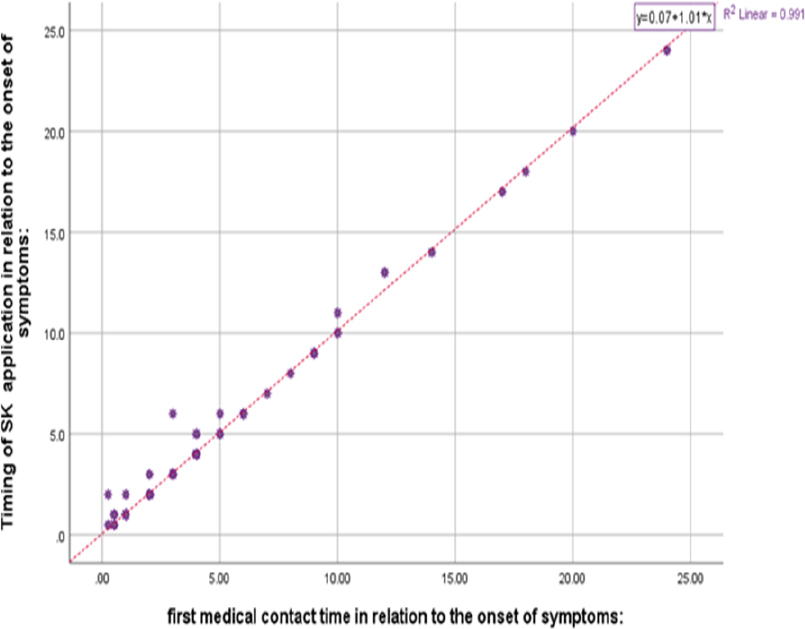
Demonstrates the relation between time from the onset of chest pain to the first medical contact (FMC) in the emergency department varied between 15 minutes and 24 hours.
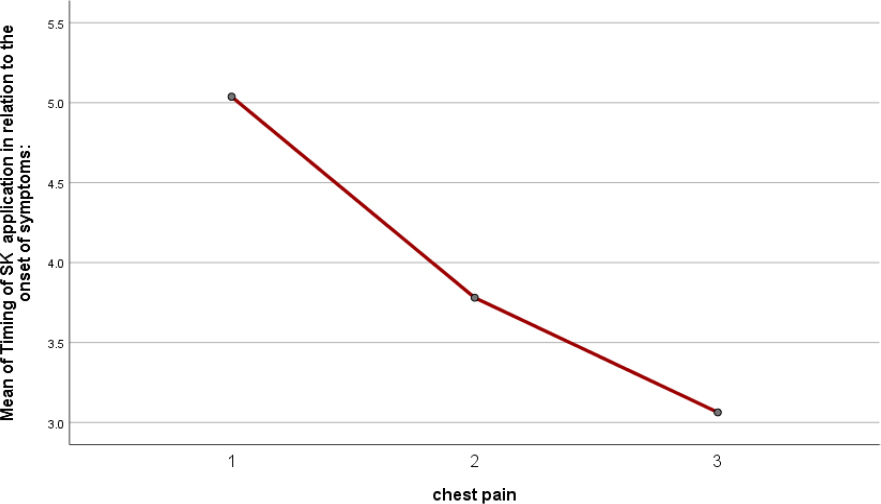
The association between the timing of streptokinase administration relative to symptom onset and the duration of chest pain reveals a notable trend. Specifically, higher efficacy in alleviating chest pain is observed when streptokinase is administered within the first three hours following the patient’s admission to the emergency department. Conversely, if its administration extends beyond five hours, the effectiveness in reducing chest pain diminishes considerably.
The study analyzed complications among patients treated with streptokinase, categorizing them into two distinct groups: early complications, which manifested within the initial 24 hours following the administration of streptokinase, and late complications, which arose after the 24-hour post-treatment period. Early complications associated with streptokinase administration were observed among the study cohort. Of the total participants, 135 individuals (68.2%) exhibited no notable complications. However, 30 patients (14.3%) developed hypotension during treatment, while 23 individuals (10.5%) experienced bradycardia. Allergic reactions, observed in 8 patients (3.6%), presented as varying degrees of pruritus, rash, and urticaria, with anaphylactic shock recorded in 3 cases. Hemorrhagic complications ranged in severity. Notably, cerebral hemorrhage was documented in 3 patients, hemoptysis occurred in 2, and minor bleeding manifestations such as cutaneous and mucosal hemorrhages were identified in 4 patients. During the administration of streptokinase, ventricular fibrillation and cardiac arrest were observed in 10 patients. Notably, all these individuals were undergoing thrombolytic therapy, with coronary angiography confirming the presence of a patent coronary artery (P=0.451).
A patient passed away during the administration of thrombolytic therapy (Table 1). Regarding late complications observed after 24 hours, cardiogenic shock was the most frequent, affecting 15 patients at a rate of 8.6%. Of these, 9 patients passed away after 24 hours of admission. Additionally, cerebral hemorrhage occurred in one patient, while another developed a large hematoma in the arm. Ventricular septal rupture was documented in a single case, and one patient experienced a recurrent myocardial infarction three days later. This patient was treated with a second dose of streptokinase since PCI could not be performed [2].
| P-value | The Count of Patients with Complications who Failed to Respond to Streptokinase. | The Count of Patients with Complications who Responded to Streptokinase. | Number of Patients with Complications from the Sample | Complication |
|---|---|---|---|---|
| 0.004 | 0 | 0 | 3 | Cerebral Hemorrhage |
| 0.384 | 14 | 16 | 20 | Bradycardia |
| 0.454 | 2 | 3 | 3 | Heart Block |
| 0.101 | 10 | 10 | 10 | Ventricular fibrillation |
| 0.045 | 17 | 24 | 30 | Hypotension |
| 0.002 | 2 | 4 | 8 | Cardiogenic shock |
| 0.326 | 7 | 9 | 11 | Allergic reaction |
| 0.065 | 0 | 0 | 1 | Cardiac death |
Finally, cardiac function was assessed in all patients at the time of hospital discharge by measuring the ejection fraction (EF). Among the patients, 39% demonstrated good cardiac function with an EF greater than 50%. Mild systolic dysfunction, characterized by an EF between 41% and 49%, was observed in 23.5%. Meanwhile, 37.5% of patients were discharged with poor cardiac function, defined as having an EF below 40%. When analyzing the correlation coefficient between the thrombus condition as the response variable and the cardiac ejection rate as a predictor variable, a statistically significant result was obtained with a P-value less than 0.0001, which is well below the significance threshold. This indicates that successful thrombolytic treatment improves the cardiac ejection rate among treated patients (Table 2).
| P-value | The Count of Patients with Complications who Failed to Respond to Streptokinase. | The Count of Patients with Complications who Responded to Streptokinase. | Number of Patients with Complications from the Sample | Complication |
|---|---|---|---|---|
| 0.0001> | 0 | 0 | 9 | Cardiac death |
| 0.002 | 1 | 4 | 15 | Cardiogenic shock |
| 0.065 | 3 | 0 | 1 | Cerebral Hemorrhage |
| 0.065 | 0 | 0 | 1 | Re-infarction |
| 0.004 | 1 | 0 | 3 | Acute Kidney Injury |
3.1. Limitations
• As a government hospital, many of the patients involved in the study come from relatively remote governorates. This distance creates significant challenges in maintaining communication and conducting follow-ups after their discharge. Consequently, it was not possible to gather sufficient data to assess long-term survival rates or complications.
• Given the limited availability of resources and the high cost of coronary intervention materials amidst a worsening economic situation, the decision to proceed with cardiac catheterization and PCI after streptokinase administration was carefully determined by the medical team's risk-based prioritization. Factors influencing this decision included young age, insufficient response to streptokinase, the need for rescue PCI, and mechanical complications. Consequently, the group of 33 patients selected comprised individuals with relatively small infarctions (lateral or inferior) who demonstrated complete clinical and vital stability following streptokinase treatment, patients aged over 75 years, or those with severe comorbidities such as advanced cancer or late-stage renal failure.
4. DISCUSSION
The management of patients with ST-elevation myocardial infarction (STEMI) has evolved significantly alongside a shift in reperfusion therapy strategies, transitioning from predominantly pharmacologic methods to catheter-based interventions. Additionally, advancements in medical treatments and the development of newer generations of fibrinolytic drugs have contributed to a continued reduction in the case-fatality rate among STEMI patients. Streptokinase, recognized as the first generation of thrombolytic agents, has become infrequently utilized in many countries, particularly within low- and middle-income settings, where its cost-effectiveness makes it a viable option for thrombolytic therapy. In contrast, high-income countries often favor newer thrombolytic agents like tissue plasminogen activator (tPA) due to their more precise mechanism of action and a lower incidence of adverse effects, as clinicians increasingly favor newer generations of thrombolytics due to their enhanced efficacy and reduced complication rates. However, during the Syrian conflict, the constrained medical landscape rendered streptokinase the sole thrombolytic option in many hospitals. Consequently, it was adopted as the primary emergency treatment in all public hospitals. This shift was necessitated by a severe shortage of essential materials and the unavailability of adequate equipment required for emergency coronary interventions. Primary percutaneous coronary intervention (PCI), a preferred treatment modality, remained restricted to a few private hospitals, where the prohibitive costs placed it beyond the financial reach of most patients, given the country's deteriorating economic conditions [9-11].
Fibrinolytic medications are categorized into two primary groups. The first group, non-fibrin-specific agents, encompasses the first generation of thrombolytic drugs, including streptokinase and urokinase. Meanwhile, the second group comprises fibrin-specific agents, which are further divided into two generations: the second generation features alteplase, while the third includes tenecteplase and reteplase. O'Gara et al. conducted an in-depth investigation into the efficacy of thrombolytic therapy for re-opening the affected artery and achieving a TIMI score of greater than 2 within 90 minutes. Their results showed that tenecteplase and reteplase achieved arterial patency rates of 85% and 84%, respectively, with tenecteplase showing a performance range of 73–84%. On the other hand, streptokinase was less effective, with success rates ranging from 60–68%. These results are closely consistent with our study, in which streptokinase showed a slightly higher efficacy of 77.5% for re-opening the target artery [12].
A notable disadvantage of streptokinase compared with other fibrinolytic agents is the high incidence of complications and side effects, especially when compared with newer, more advanced options. In our study, the most common complication among patients was hypotension while taking streptokinase. Streptokinase-induced hypotension is a frequently observed adverse reaction in patients undergoing streptokinase therapy for acute myocardial infarction. Despite its prevalence, there is limited clinical evidence elucidating the exact mechanisms responsible for this condition. Several factors have been proposed, including drug hypersensitivity, rapid administration, or vasodilation. However, a systematic review has concluded that the primary mechanism is most likely linked to a significant decrease in total peripheral resistance. Entezari-Maleki et al. [13] reported that the incidence of hypotension during streptokinase therapy ranges between 1% and 10%, a finding consistent with the results of our study, which constituted 14.3%. However, these rates are significantly lower compared to those documented in another Iranian study, where the incidence exceeded 50%. The researchers attributed this discrepancy to the rapid administration of streptokinase, which may have contributed to the markedly higher prevalence of hypotension in their study [14].
The second most frequent complication associated with fibrinolytic therapy is bleeding, with cerebral hemorrhage being the most severe and life-threatening manifestation. Data from the GISI-1 and ISIS-2 trials indicate that the incidence of major bleeding events, such as hemorrhagic stroke, was reported to range between 0.3% and 0.5% [15]. This is largely consistent with the rate found in our study and was lower than the rate reported by Khalid et al. in their systematic review, where the rate of cerebral hemorrhage was 1.5% [14-17].
The LATE and EMERAS trials, when analyzed collectively, offer compelling evidence that administering thrombolytic agents between 6 to 12 hours after the onset of ischemic symptoms can still lead to a noticeable reduction in mortality. These studies underscore the efficacy of early thrombolysis in decreasing mortality rates both in the short term and over extended periods. The worsening security situation in Syria has significantly impacted rural healthcare facilities, disrupting the ambulance system and causing critical delays in transporting patients to well-equipped hospitals during the vital golden hour. As a result, initial medical contact with patients often takes place more than 120 minutes after symptoms arise, with some cases experiencing delays of up to 12 hours from the onset of acute pain. As with survival, improvement in global LV function is related to the time of initiation of fibrinolytic treatment, with the greatest improvement occurring with the earliest therapy [18, 19].
Numerous reference studies have demonstrated that patients who received early treatment for STEMI experienced significant improvements in left ventricular global function compared to those who underwent delayed treatment. In the latter group, left ventricular function was often more severely impaired and, in many cases, irreversible. A key distinction between these studies and ours lies in the assessment methods employed. The referenced studies utilized advanced and highly precise techniques such as cardiac magnetic resonance imaging, positron emission tomography, and single-photon emission tomography. In contrast, our study relied on calculating the ejection fraction to evaluate left ventricular function. While this method is known to be limited in accuracy and insufficient for comprehensive assessment, it was the only option available to us due to the unavailability of cardiac magnetic resonance imaging equipment and an insufficient supply of materials needed for scintigraphy to include all study participants [20, 21].
5. LIMITATIONS AND FUTURE DIRECTIONS
Following the administration of streptokinase, there is a marked increase in anti-streptokinase antibodies and their neutralization titers as early as four days after the initial dose. These elevated antibody levels persist for at least four years in nearly 50% of patients. The presence of these antibodies can lead to allergic reactions or neutralize subsequent doses of streptokinase, significantly reducing its efficacy in treating myocardial reinfarction. As a result, streptokinase is strongly contraindicated within six months of prior exposure due to the heightened risk of severe allergic reactions [16]. Data from the GISSI and GUSTO trials reported approximately a 5% incidence of allergic reactions in patients administered a first dose of streptokinase, with most reactions being mild and including symptoms such as rash, transient fever, or rigors. This aligns closely with our study, which observed an allergy incidence rate of 3.6% [15, 17]. Given our present circumstances, the administration of streptokinase as an emergency treatment during the critical initial hours following the onset of chest pain continues to represent a highly effective strategy for saving numerous lives. This assertion is substantiated by extensive research and a multitude of systematic reviews.
It is important to note that long-term follow-up after hospital discharge posed a significant challenge to the study. Prevailing security and social conditions during the study period made it particularly difficult to maintain consistent contact with patients. The majority of individuals who received treatment continued their care at cardiology clinics or smaller local hospitals.
CONCLUSION
Streptokinase, despite its age and restricted use in only a few developing countries, continues to demonstrate significant effectiveness in saving lives and lowering mortality rates among infarction patients when compared to conservative treatment. This conclusion stems from our experience treating thousands of patients in Syrian public hospitals over a decade, during the tumultuous period of the Syrian revolution and ongoing war. The findings of our study support this conclusion by comparing the clinical effectiveness of streptokinase administered in emergencies with the outcomes observed through coronary angiography in assessing the target artery. The purpose of this study was to illuminate a challenging period in our nation's history, marked by significant hardships and obstacles in our pursuit of effectively managing emergency cardiac cases.
AUTHORS’ CONTRIBUTIONS
The authors confirm their contributions to the paper as follows: M.N.k.: Patient follow-up, data collection, wrote the main manuscript text; K.A., A.H. and B.D.: Data collection; M.Y.B. and A.A.: Supervision. All authors reviewed the results and approved the final version of the manuscript.
LIST OF ABBREVIATIONS
| LV | = Left Ventricle |
| MI | = Myocardial infarction |
| BMI | = Body mass index |
| TIMI | = Thrombolysis in Myocardial Infarction |
| STEMI | = ST-segment elevation myocardial infarction |
| EF | = Ejection fraction |
| ECG | = electrocardiogram |
| PCI | = Percutaneous coronary intervention |
| FMC | = First medical contact |
| CABG | = Coronary artery bypass grafting |
| TPA | = Tissue plasminogen activator |
ETHICS APPROVAL AND CONSENT TO PARTICIPATE
Ethical approval exemption for this study was obtained from the medical director of Damascus Hospital for Cardiology and Cardiac Surgery, Syria on 1/ June /2024.
HUMAN AND ANIMAL RIGHTS
All procedures performed in studies involving human participants were in accordance with the ethical standards of institutional and/or research committees and with the 1975 Declaration of Helsinki, as revised in 2013.
CONSENT FOR PUBLICATION
Consent to participate in the advertisement in the manuscript was obtained from all patients.
AVAILABILITY OF DATA AND MATERIALS
The data and supportive information is available within the article.
ACKNOWLEDGEMENTS
Declared none.